










TOP

Since the first product was approved in 2018, small interfering RNA (siRNA) drugs have demonstrated clinical value in rare diseases, metabolic diseases, and other fields. However, when faced with complex diseases such as tumors and cardiovascular diseases driven by multi-gene network dysregulation, single-target strategies often struggle. Dual-target siRNA technology has emerged as one of the most promising directions for RNA interference (RNAi) therapy. Since 2026, this sector has seen intensive breakthroughs from technology validation to clinical pipelines.

The pathological mechanisms of complex diseases often involve multiple signaling pathways. Take tumors as an example: simply inhibiting proliferation pathways cannot block angiogenesis or eliminate the immunosuppressive microenvironment.
The dual-target siRNA aims to achieve synergistic effects by simultaneously silencing two pathogenic genes with a single drug. Currently, mainstream technology approaches fall into two categories: first, single-molecule, dual-target design, which connects two siRNA sequences using a sophisticated scaffold; The second is the nanoco-delivery system, which uses nanoparticles to simultaneously encapsulate two independent siRNA molecules.

Key breakthroughs in 2026: Dual successes in clinical and preclinical practice
Entering 2026, the dual-target siRNA field will reach multiple milestone events, marking the official transition of the technology from academic exploration to clinical development.
Cardiovascular field: The world's first dual-target siRNA enters clinical trials
Rona Therapeutics's RN5681 has initiated Phase I clinical trials in the first quarter of 2026. As the world's first dual-targeted PCSK9-LPA siRNA to enter clinical trials, this drug simultaneously silences both PCSK9 and LPA genes with a single molecule, aiming to achieve "two reductions with one injection"—lowering LDL-C and Lp(a) levels simultaneously, providing a revolutionary dosing regimen for patients with atherosclerotic cardiovascular disease that is administered every 6-12 months.
Nephrology/Immunology: Preclinical breakthroughs in dual blockade of the complement pathway
FB7011 developed by Frontier Biotech is a dual-target siRNA drug targeting MASP-2 and CFB, aiming to simultaneously block the lectin pathway and alternative pathway in the complement system. Preclinical data show that after a single subcutaneous administration in crab-eating macaques, FB7011 inhibited both targets by over 95%, with effects lasting more than 12 weeks.
This drug achieves highly efficient liver-targeted delivery through GalNAc conjugation technology, mainly used to treat complement-mediated diseases such as IgA nephropathy, and is expected to achieve ultra-long-acting regimens with dosing every 4-6 months.
Oncology: STP355 validates the potential of solid tumors
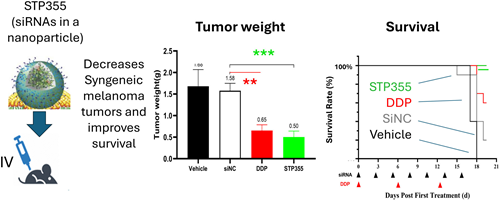
In January 2026, preclinical data published by Sirnaomics showed that the candidate drug STP355, targeting TGFβ1 and VEGFR2, reduced tumor weight by 70% in melanoma models, improved mouse survival from 0% to 100%, and reduced lung metastases by more than 50%. The drug can also reshape the tumor immune microenvironment, increasing the number of tumor-infiltrating T cells and natural killer cells by nearly four times.

Central nervous system: achieving long-lasting gene silencing

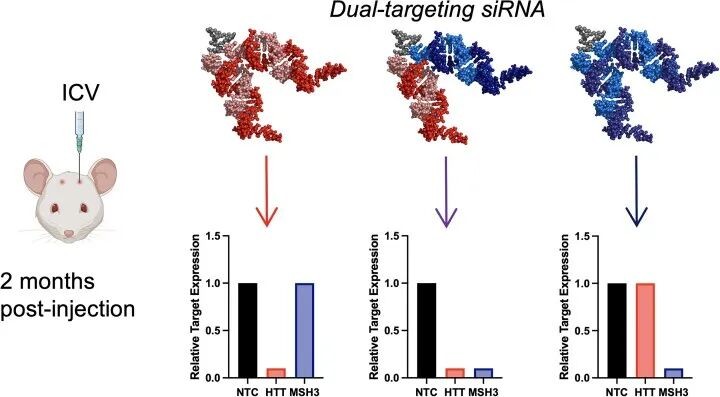
A single-molecule, dual-target siRNA designed by the University of Massachusetts Medical School team can simultaneously silence the MSH3/HTT genes related to Huntington's disease or the APOE/JAK1 genes related to Alzheimer's disease, achieving continuous target gene silencing for up to two months in mouse CNS.

Oncology Field: Dual targeting strategies for hepatocellular carcinoma markers and drivers
The GP73/hTERT dual-target siRNA developed by Zhejiang Sci-Tech University and other institutions uses a novel biosynthesis platform for E. coli to synthesize branches, simultaneously targeting the hepatocellular carcinoma marker GP73 and telomerase reverse transcriptase hTERT. In liver cancer cell and tumor-bearing mouse models, this molecule demonstrated significant dual-gene silencing effects and antitumor activity, providing an innovative strategy for liver cancer treatment that balances diagnostic biomarkers and immortalization drivers.
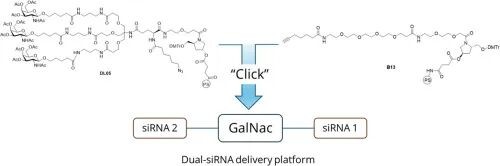
Mature applications of liver targeting: GalNAc conjugation technology has made the fastest progress in the liver-targeted dual-target siRNA. Rona Therapeutics's RN5681 is based on this technology, and other research has reported a modular platform based on click chemistry to achieve structure-uniform liver-targeted multi-gene silencing.
Breakthrough in extrahepatic delivery: Sirnaomics' PNP platform validates the feasibility of systemic drug delivery for treating solid tumors. RiboPepSTAR™ platform launched by Ribo Life Science achieves up to 96% knockdown of target genes in adipose tissue in non-human primates.
Business landscape: Giants entering the market and high-value collaborations
In February 2026, Ribo Life Science and Madrigal Pharmaceuticals reached a global exclusive licensing agreement to jointly develop six siRNA therapies targeting metabolic dysfunction-associated steatohepatitis (MASH), including dual-target assets. The total transaction amount reached $4.4 billion, fully demonstrating the commercial potential of dual-target siRNA in this heavyweight sector.
Meanwhile, BeBetter Med Inc's AGT/PCSK9 dual-target siRNA drug BEBT-701 recently received approval from the China NMPA for clinical trials.
Dual-target siRNAs still face challenges such as balancing target efficiency, potential toxicity, and large-scale synthesis. However, as delivery systems evolve from "liver-targeted" to "multi-organ targeting," siRNA drugs are evolving from "single-targeting" to "collaborative operations" in regulating complex disease networks.
Dual-target and even multi-target siRNAs will become key markers for next-generation RNAi therapies, bringing new hope to unmet clinical needs. In this process, GentleGen can provide related dual-target design and synthesis technology services. For detailed information about related services, please send an email to marketing@gentlegen.com.