







Article Title:Macrophage piezo1 senses mechanical force to driveosteoclastogenesis via ZBP1: Implications for boneremodelling therapy
Article Link:https://pubmed.ncbi.nlm.nih.gov/42175670/
Journal Name:Clinical and Translational Medicine
Impact factor: 7.9
Clients: Nanjing Medical University, Nanjing Medical University Affiliated Stomatological Hospital, Jiangsu Provincial Translational Medicine Engineering Research Center
GentleGen provides services: virus packaging
Experimental Background: An unknown part of mechanical force induction in bone remodeling
Orthodontic tooth movement faces two major clinical challenges: significant individual differences and risks of root resorption. Recent studies have revealed that aseptic inflammation-driven imbalance in bone remodeling is the core mechanism of alveolar bone remodeling, rather than a purely biomechanical effect. Macrophages are considered key mechanosensing cells, but the molecular pathway by which they convert mechanical stress into osteoclastic differentiation signals remains unclear. Although the mechano-sensitive channel Piezo1 participates in immune regulation, its downstream connection to mechanical stimulation and signal nodes for osteoclast generation remains unclear.
The research team at Nanjing Medical University aims to fill this theoretical gap and reveal the direct molecular link between macrophage mechanical transduction and inflammatory bone resorption.
Experimental Method: Multi-level integrated research strategy
The study adopts a three-level progressive experimental design of "clinical samples—animal models—cellular mechanisms":
Clinical Perspective:
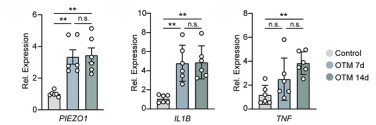
Periodontal membrane tissue from orthodontic patients was collected and evaluated by qPCR and immunofluorescence staining to assess changes in PIEZO1, IL1B, TNF expression, and PIEZO1-CD68-macrophage infiltration before and after mechanical loading.

Internal Animal Level:
Established mouse orthodontic tooth movement models and femoral fracture healing models; Constructed macrophage-specific conditional gene knockout mice and validated the functional necessity of Piezo1 and ZBP1 in bone remodeling in in vivo.
Extracellular Dimension:
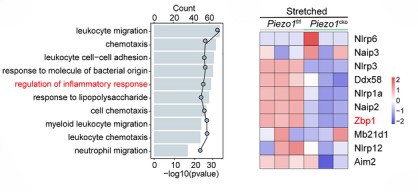
Cyclic tensile strain simulated mechanical stimulation was applied to bone marrow-derived macrophages, combined with RNA-seq-resolved transcriptome reprogramming, and the ZBP1 small molecule regulator was identified through virtual screening and CETSA.
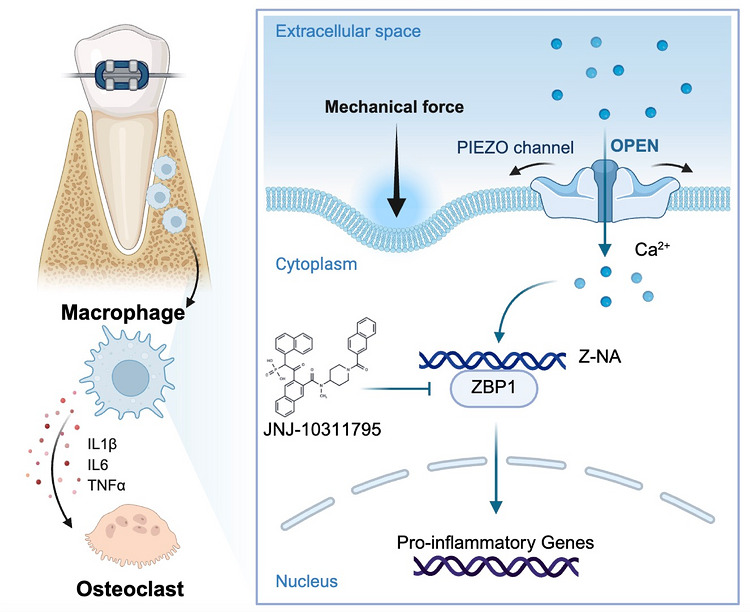
The study revealed a Piezo1-ZBP1 mechanical force–immune signaling axis, forming a novel molecular switch that converts mechanical stress into inflammatory bone resorption. The core events are:
Mechanical stress sensing—mechanical gated activation of the Piezo1 ion channel
Piezo1 is a mechanically sensitive cation channel on the plasma membrane of macrophages. Orthodontic force alters membrane tension, inducing channel opening, triggering extracellular Ca²⁺ inflow, converting mechanical energy into intracellular calcium signals.
Signal amplification and transduction—transcription upregulation of ZBP1
Intracellular Ca²⁺ drives upregulation of Z-DNA binding protein 1 (ZBP1) through the calmodulin-dependent pathway (CaMKII/NFAT). ZBP1 acts as a downstream effector molecule of Piezo1, mediating the reprogramming of inflammation-related genes. Genetically, Zbp1 overexpression can completely save the bone remodeling phenotype of Piezo1-deficient mice.
Functional output — release of inflammatory factors and osteoclast production
Upregulation of ZBP1 promotes the release of pro-inflammatory factors such as TNF-α, IL-1β, and IL-6; paracrine effects act on osteoclasts to drive their differentiation into mature osteoclasts, mediating alveolar bone resorption.
Functional validation and bidirectional pharmacological regulation

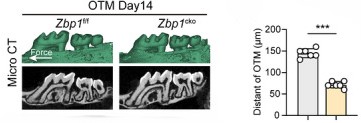
Macrophage-specific knockout of Piezo1 or Zbp1 can significantly slow OTM and preserve bone mass. Obtaining ZBP1 small molecule regulators through virtual screening enables bidirectional regulation: inhibiting bone resorption to slow OTM, while promoting bone formation to accelerate fracture healing.

In summary, this study defines the Piezo1-ZBP1 axis as the core switch in macrophages where mechanical stress drives inflammatory bone resorption.
In the process of achieving macrophage-specific gene manipulation, the research team employed a virus-mediated gene delivery strategy, achieving targeted editing through bone marrow-derived macrophages infection or in situ injection.
GentleGen provided key viral packaging services for this study, with technical contributions reflected in the following three aspects:
High-titer virus preparation: GentleGen's lentiviral packaging platform ensures that the overexpression vector (ZBP1) has an infection titer of ≥1×10⁸ TU/mL, guaranteeing efficient transduction of primary macrophages and in vivo tissues, which is a technical prerequisite for robust phenotypic development.
Vector quality control and experimental rigor assurance: The target virus provided by GentleGen and the control virus remain completely consistent in EGFP fluorescent labeling and Puro resistance, eliminating confounding variables caused by fluorescence intensity and drug screening differences on experimental results, and ensuring strict comparability between the gene control group and control group in cell sorting and stable strain screening.
Technical support for one-stop gene services: GentleGen's automated and intelligent gene technology platform covers the entire process from vector construction and plasmid preparation to viral packaging and titer detection, saving research teams cumbersome virus production time and quality control costs, allowing researchers to focus their core efforts on downstream mechanism exploration and phenotyping validation.
GentleGen acted as a high-quality "technology provider" for genetic tools in this study, offering reliable and repeatable experimental tools for in vivo and in vitro functional validation of the Piezo1-ZBP1 axis. For more details about related services, you can send an email to marketing@gentlegen.com.