






Why is it necessary to conduct document quality inspection before experimenting with CRISPR Screen?
The sgRNA library is the "arsenal" of CRISPR screening, and its quality directly determines the success or failure of the experiment. The core of library quality inspection is to verify two key indicators: coverage (whether sgRNA covers all target genes) and uniformity (whether the abundance of each sgRNA is balanced).
In-depth sequencing of the original plasmid library via NGS can assess whether sgRNA sequences are favored for over-enrichment or loss during amplification. If library homogeneity is poor (i.e., some sgRNAs account for too much and others are almost undetectable), then there is already "bias" before screening, and subsequent enrichment analysis loses reliability.
In short, CRISPR Screens that do not perform document quality checks will only result in numerous vulnerabilities.
After screening, how deep should NGS sequencing be achieved?
Sequencing depth is another determinant of CRISPR Screen data quality. It is generally recommended that each sample be sequenced at least 300 times the size of the library.
For example, for a library targeting 20,000 genes and designing 6 sgRNAs per gene (totaling 120,000 sgRNAs), the sequencing data volume per sample should ensure that each sgRNA is read more than 300 times on average, meaning the total reads must not be less than 36 million.
If sequencing depth is insufficient, low-abundance sgRNA may be lost due to random sampling, resulting in false negatives; However, higher depth is not always better; excessive depth can lead to unnecessary costs. The ideal sequencing depth should ensure data saturation while balancing cost-effectiveness—usually using the sgRNA abundance distribution curve as the standard for smoothing.
What are the differences between positive and negative filtering in data analysis?
Positive screening: cells survive and enrich under screening pressure. For example, in the drug treatment group, cells carrying specific sgRNAs expand due to developing resistance, resulting in increased sgRNA abundance. The focus is on significantly enriched sgRNA or genes during analysis, commonly using the RRA score (the lower the score and the higher the ranking, the more likely the gene is the target gene).
Negative screening: Cells that knock out essential genes die and are eliminated during screening, resulting in a decrease in sgRNA abundance. The analysis focuses on significantly depleted sgRNA or genes.
The two types of filtering data analysis strategies differ: positive filtering focuses on "who has gone up," while negative filtering focuses on "who has fallen." During the experimental design phase, the direction of screening should be clearly defined to facilitate the subsequent selection of appropriate statistical models.
Is there a difference between the dual plasmid system and the single plasmid system during NGS analysis?
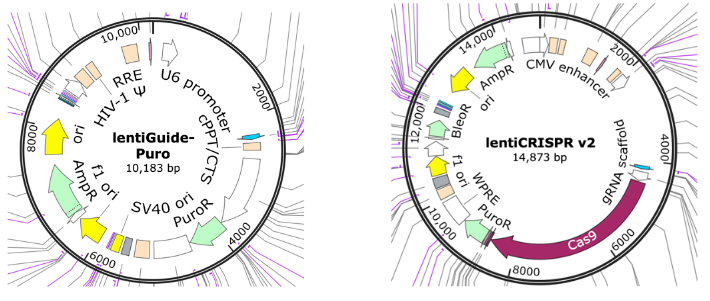
Dual plasmid system: sgRNA and Cas9 are loaded onto two different plasmids, transducting cells sequentially (Cas9 stable transmutation first, then sgRNA library); LentiGuide-Puro carrier is commonly used;
Single plasmid system: integrates sgRNA and Cas9 into the same plasmid, enabling one-step transduction; lentiCRISPR v2 carrier is commonly used.

The logic for both NGS analyses is the same: both use PCR to amplify sgRNA regions, perform deep sequencing, and compare the changes in sgRNA abundance before and after screening.
The difference lies in experimental design and operation: the dual plasmid system requires first screening for Cas9 stable transplanting, which takes longer but offers greater flexibility; Single-plasmid systems are easier to operate and more stable to integrate.
When providing NGS services, we utilize plasmid mapping to design appropriate PCR primers and determine sgRNA skeleton sequences. Regardless of the system, as long as complete carrier information is provided, the analysis process is standardized.
GentleGen provides one-stop gRNA library services
GentleGen has built a gene service technology platform integrating automation and intelligence, embedding an integrated link between gene synthesis, oligonucleotide synthesis, high-throughput sequencing, and gene editing services, providing a truly standardized, highly precise, and cost-effective one-stop solution for CRISPR sgRNA library construction and screening.
Ultra-high synthesis accuracy ensures every sgRNA is precisely positioned
Relying on its self-developed oligonucleotide synthesis platform, GentleGen has achieved an ultimate mutation rate of 1‰ in oligonucleotide synthesis—meaning that for critical sequence lengths, GentleGen can ensure that over 90.5% of sgRNA sequences perfectly match theoretical designs, guaranteeing precise targeting of every gRNA from the sequence source!
Coverage ≥99%, uniformity <10, using data to define the standards for high-quality libraries
Coverage and homogeneity are the "golden dual cores" for evaluating document quality. Under a strict quality control system, GentleGen delivers over 99% library coverage to clients, while maintaining an industry-leading level of uniformity below 10.
High-standard quality control + NGS deep sequencing verification, data speaks for itself at a glance

Once the library is built, it is not simply a matter of packaging and shipping. GentleGen independently validates every delivered plasmid library strictly according to the NGS sequencing depth ≥300× standard, delivering high-purity, endotoxin-free plasmids (total amount ≥ 200μg), giving you the control over quality during the "first mile" of experiments without extra effort.

A path just for you, with customizable personalized library solutions
There are many directions for basic research or drug development. For whole-genome exploration, GentleGen can directly provide standardized human and mouse whole-genome knockout libraries to support large-scale genetic screening efforts. For specific needs for precisely targeting specific signaling pathways or target gene sets, GentleGen's customized services are always on standby, tailoring and synthesizing each client's unique targets.
From screening to validation, chain-based delivery enables closed loops to arrive faster
Relying on strong NGS bioanalytical capabilities and long-term gene editing experience, GentleGen is not limited to library plasmid construction—from lentiviral packaging, cell infection, screening pressure application, to final high-throughput sequencing and data analysis, GentleGen can scientifically and reasonably integrate generations, helping researchers shorten project cycles, quickly lock onto "targets," and achieve a complete validation closed loop.