










热线电话:+86 512 6799 8818

在线咨询

TOP

*姓名

*电话

邮箱

咨询内容

*验证码

联系销售


Sales Image

联系销售助理


Sales Assistant Image

联系PM


PM Image
GentleGen Observations | A New Milestone for In Vivo CRISPR: EDIT-401 Enters Clinical Trials, Marking a Breakthrough in Gene Therapy for Chronic Diseases
Release time:2026-10-22
Share:

On October 8, Editas Medicine announced that its in vivo CRISPR therapy EDIT-401 had received clinical approval, officially launching a Phase I/II human trial for heterozygous familial hypercholesterolemia (HeFH). This marks the transition of in vivo CRISPR technology from traditional rare blood diseases to the track of metabolic chronic diseases with a larger patient base.


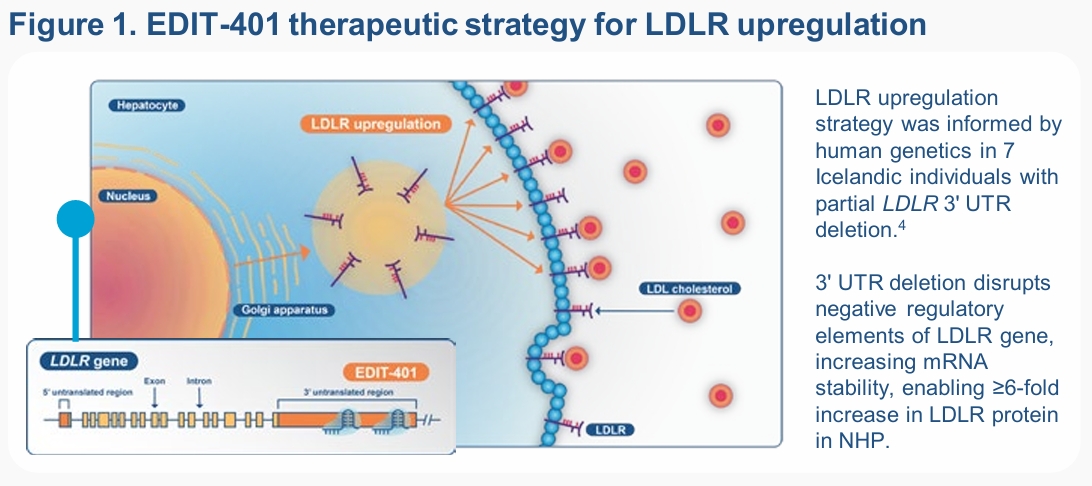
EDIT-401 is a non-viral delivery liver-targeted in vivo CRISPR-Cas gene editing therapy. The drug acts on liver cells, upregulating LDL receptor (LDLR) expression through genome-targeted editing techniques, thereby achieving a long-term therapeutic effect in lowering low-density lipoprotein cholesterol (LDL-C).


Heterozygous familial hypercholesterolemia: a huge unmet clinical need

Heterozygous familial hypercholesterolemia (HeFH) is an autosomal dominant genetic disorder and is also the most common familial hypercholesterolemia subtype in clinical practice.


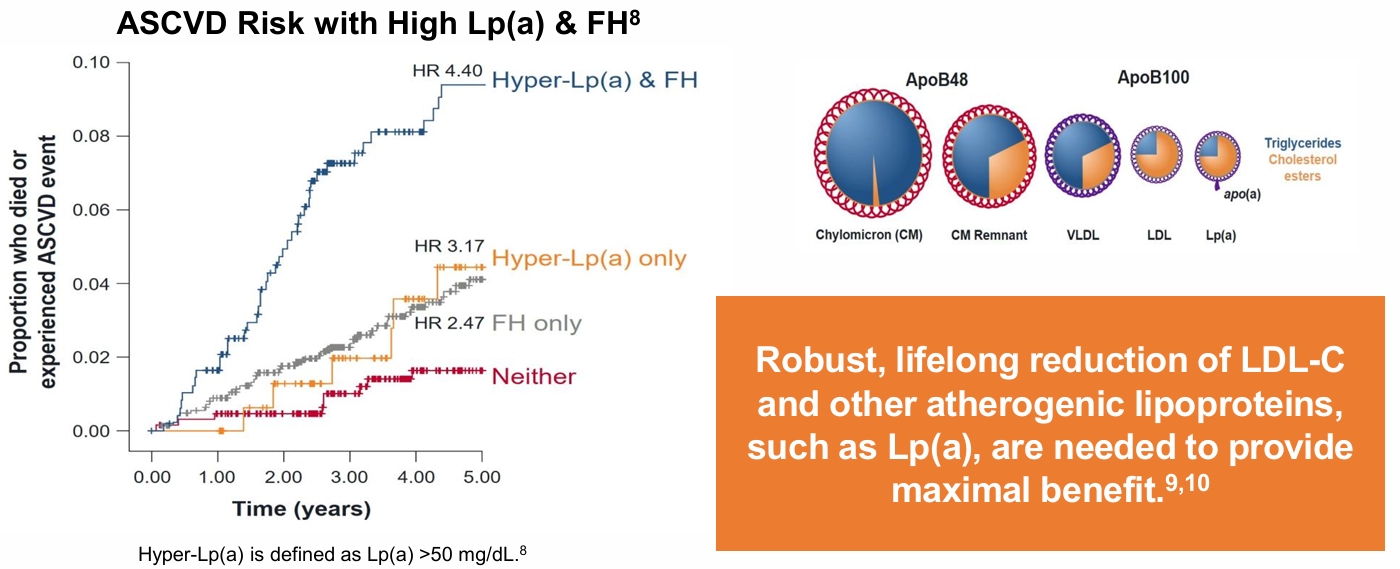
Patients are born with LDLR gene defects, resulting in insufficient LDL receptor counts on liver cell membranes, making it impossible to effectively clear low-density lipoprotein in the blood. Patients experience significantly elevated cholesterol from adolescence, with a greatly increased risk of early myocardial infarction, coronary heart disease, and aortic atherosclerosis.


屏幕截图_19-10-2026_17539_www.editasmedicine.com


The mainstream current treatment regimens are statins and PCSK9 inhibitors.


These drugs can effectively control blood lipids, but they have obvious drawbacks: they require long-term, uninterrupted medication, and once stopped, lipid levels rebound, making it impossible to fundamentally repair genetic defects. There remains a significant unmet treatment gap in clinical practice.


Drug design and preclinical data performance

The core design concept of EDIT-401 is to activate the LDLR pathway in situ in the liver through a single dose, achieving long-term lipid reduction and eliminating dependence on long-term medication.


屏幕截图_19-10-2026_165322_www.editasmedicine.com


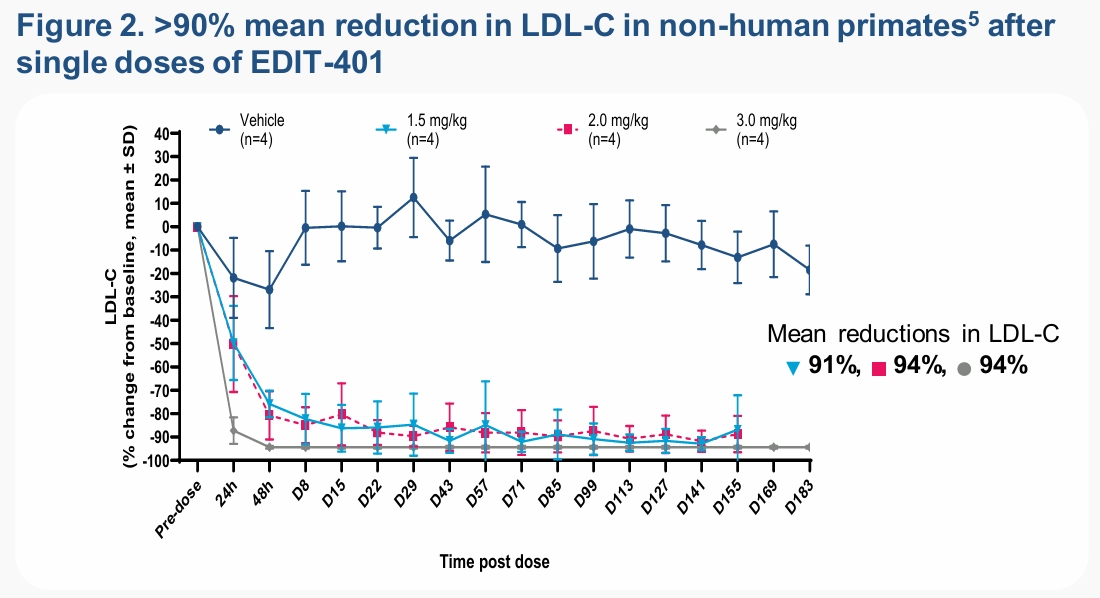
In previous non-human primate experiments, after a single dose, LDL-C in animals showed a sustained decrease, the lipid-lowering effect could last for months, and the risk of off-target editing remained within a controllable range.


屏幕截图_19-10-2026_165342_www.editasmedicine.com


Unlike previous pipelines, HeFH is a high-incidence chronic metabolic disease, with a patient population far larger than that of rare blood diseases.


The launch of this clinical trial means that CRISPR in vivo is moving beyond niche rare diseases and is targeting larger patient populations, further expanding the commercial application boundaries of gene editing.


Industry Landmark Significance

Previously, in vivo CRISPR development focused on genetic diseases of the hematologic system. Cardiovascular and metabolic chronic diseases have a broader audience, but their evaluation standards for editorial safety, long-term toxicity, and CRISPR system accuracy are even stricter.


屏幕截图_19-10-2026_165441_www.editasmedicine.com


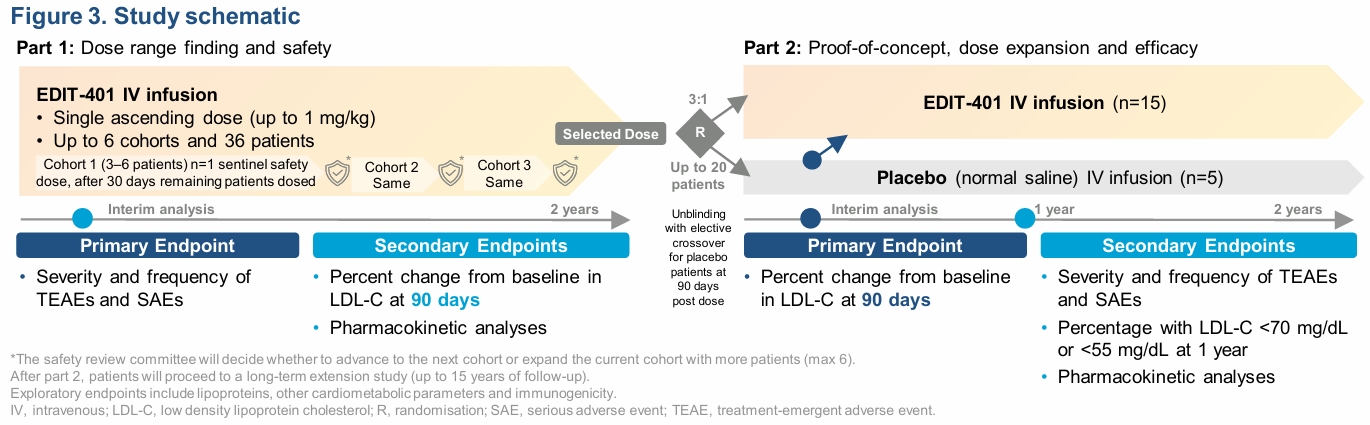
This Phase I/II clinical trial will focus on several core metrics:

  1. Safety and tolerability of a single dose in humans;

  2. The degree of decrease in LDL-C at different dose gradients;

  3. The duration during which the drug's effects can be maintained;

  4. The occurrence of off-target editing events in vivo.


The trial results will be announced soon, addressing a highly important question in the industry: whether in vivo CRISPR can be safely and long-acting for chronic disease treatment, and will provide important clinical references for subsequent liver-targeted gene editing pipelines.


GentleGen: One-stop gRNA library service

EDIT-401's successful advancement in human clinical trials further confirms the underlying logic of CRISPR drug development: sgRNA design, target validation, off-target evaluation. Whether it is target screening at the basic research level or early development of gene-edited drug candidates, building a stable and reliable CRISPR system and validating its function are prerequisites for the project's success.


GentleGen has built a gene service technology platform integrating automation and intelligence, embedding an integrated link between gene synthesis, oligonucleotide synthesis, high-throughput sequencing, and gene editing services, providing a truly standardized, highly precise, and cost-effective one-stop solution for CRISPR sgRNA library construction and screening.


  • Ultra-high synthesis accuracy ensures every sgRNA is precisely positioned

Relying on its self-developed oligonucleotide synthesis platform, GentleGen has achieved an ultimate mutation rate of 1‰ in oligonucleotide synthesis—meaning that for critical sequence lengths, GentleGen can ensure that over 90.5% of sgRNA sequences perfectly match theoretical designs, guaranteeing precise targeting of every gRNA from the sequence source!


  • Coverage ≥99%, uniformity <10, using data to define the standards for high-quality libraries

Coverage and homogeneity are the "golden dual cores" for evaluating document quality. Under a strict quality control system, GentleGen delivers over 99% library coverage to clients, while maintaining an industry-leading level of uniformity below 10.


  • High-standard quality control + NGS deep sequencing verification, data speaks for itself at a glance

Once the library is built, it is not simply a matter of packaging and shipping. GentleGen independently validates every delivered plasmid library strictly according to the NGS sequencing depth standard ≥300×, delivering high-purity, endotoxin-free plasmids (total ≥ 200μg), allowing you to control quality right from the "first mile" of experiments without extra effort.


  • A path just for you, with customizable personalized library solutions

There are many directions for basic research or drug development. For whole-genome exploration, GentleGen can directly provide standardized human and mouse whole-genome knockout libraries to support large-scale genetic screening efforts. For specific needs for precisely targeting specific signaling pathways or target gene sets, GentleGen's customized services are always on standby, tailoring and synthesizing each client's unique targets.


  • From screening to validation, chain-based delivery enables closed loops to arrive faster

Relying on strong NGS bioanalytical capabilities and long-term gene editing experience, GentleGen is not limited to library plasmid construction—from lentiviral packaging, cell infection, screening pressure application, to final high-throughput sequencing and data analysis, GentleGen can scientifically and reasonably integrate generations, helping researchers shorten project cycles, quickly lock onto "targets," and achieve a complete validation closed loop.


For detailed information about related services, please send an email to marketing@gentlegen.com.

Pre-sales consulting
Pre-sales consulting
A more reliable solution for your needs.
Download

Download

Welcome to our product library.
Sales network

Sales network

Complete sales and service network to ensure product quality.
Event Promotions

Event Promotions

Add to cart now and enjoy this shopping extravaganza!