











Article Title: Compact 9dBEs Enable Efficient and Precise Genome Editing in Mammalian Cells and In Vivo
Article link: https://advanced.onlinelibrary.wiley.com/doi/full/10.1002/advs.77279
Published in: Advanced Science
Impact factor: 14.1
Clients: Zhejiang University, Northwest A&F University, Institute of Neuroscience, ShanghaiTech University, Hangzhou Medical College, Shanghai Institute of Materia Medica, Zhongshan Institute of Drug Innovation
GentleGen provides services: GUIDE-seq
Why make a "small" editor: delivery dilemma versus compact chassis
Base editors can complete base conversion on the genome without cutting the DNA double strand or needing a donor template. However, mainstream SpCas9 systems are relatively large in volume, and the commonly used in vivo AAV vectors carry limited capacity, making it difficult for large proteins combined with guide RNA and regulatory elements to fit into a single AAV.
Previous small solutions each had their shortcomings: some small Cas9 homologs still had around a thousand amino acids; Systems such as TnpB, Cas12f, and Fanzor lack complete HNH domains; Although IscB is compact and retains the HNH domain, its interval sequences are relatively short, limiting the targeting range, and short intervals also lead to more potential off-target sites.
The study base was MG34-1, an II-D Cas9d isologue from Deltaproteobacteria, with a volume between IscB and larger Cas9, retaining standard length interval sequences to identify NGG PAM; Wild-type activity is undetectable in mammalian cells. The significance of this research is precisely to transform a compact chassis that theoretically has delivery potential but remains "silent" in the mammalian system, into a usable editing tool.
Dual modification of gRNA and protein yielded highly active Cas9dUltra
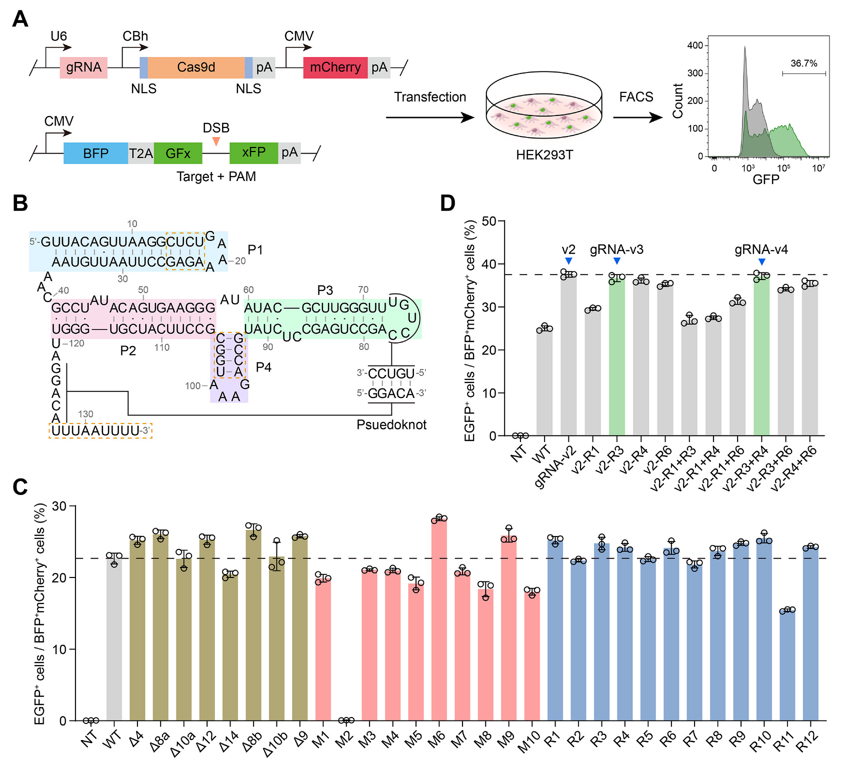
Using Cas9d-gRNA-dsDNA ternary complex structure prediction and cryo-EM data, the team analyzed stem loops and ring regions of the gRNA backbone and iteratively modified them: truncating redundant stem loops, removing excess bases at 3′, replacing swing pairs with more stable G:C pairs, and optimizing pseudojunction pairs to obtain shorter, more active gRNA-v3.

Engineered gRNA scaffolds enhance Cas9d cleavage activity and reduce volume
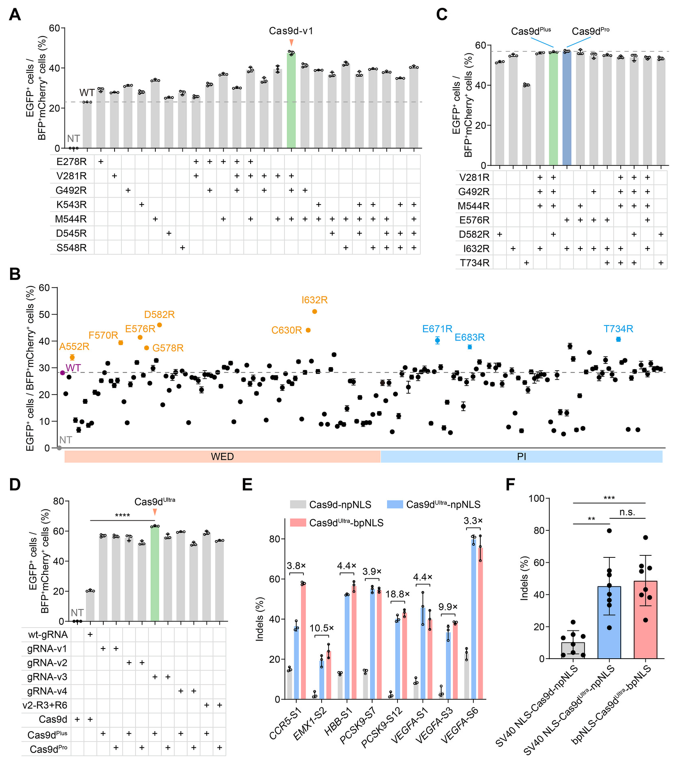
Protein engineering first scans arginine substitutions in three RuvC domains—positively charged arginine enhances interaction between effector proteins and gRNA-target DNA complexes; After screening for beneficial mutations, they were further expanded to the WED and PI domains to obtain highly active Cas9dPlus. When combined with the optimized gRNA-v3, it forms Cas9dUltra.

The engineered Cas9d protein enhances nuclease activity in mammalian cells
In the reporting system, the modified system's cutting efficiency is about three times higher than that of the wild type; The positioning signals at both ends perform best at the internal source site. In a horizontal comparison with SlugCas9 and OgeuIscB at multiple endogenous sites in humans, Cas9dUltra showed significantly better efficiency than OgeuIscB, but similar to but slightly lower than SlugCas9.
Specificity validation: whole-genome screening and two types of off-target assessment

The expression and specificity of 9dBEs in human cells
The study evaluated specificity from two perspectives: in mismatch testing, Cas9dUltra had very low tolerance for continuous bimismatches in the interval region. Genome-wide unbiased screening was conducted using GUIDE-seq, at multiple endogenous sites: Cas9dUltra detected significantly fewer off-target sites than the control OgeuIscB, and some sites did not detect off-target.
GUIDE-seq introduces short double-stranded oligonucleotide-labeled cleavage events into cells, followed by enrichment of labeled fragments, library sequencing, and locus localization; After fragmentation, end repair, and splicing, the genomic DNA was enriched with marker fragments through two rounds of nested PCR and ultimately sequenced bi-end on the Illumina NovaSeq 6000. GentleGen provides sequencing work for the GUIDE-seq stage.

Derived base editors: 9dABE and 9dCBE
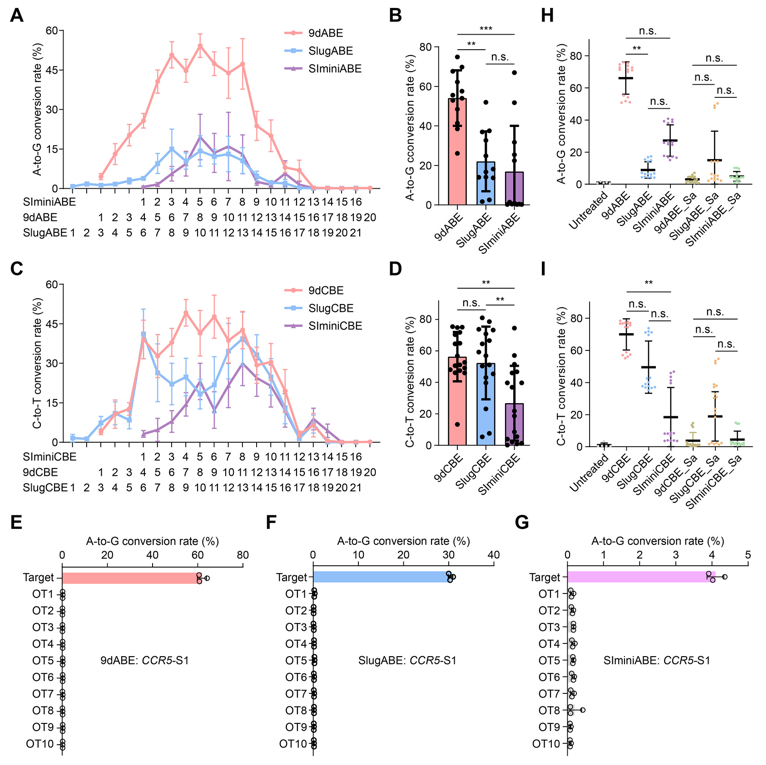
Fusion of Cas9dUltra incision enzyme with deaminase: 9dABE handles A-to-G, 9dCBE handles C-to-T. Compared with similar small base editors, both have the same or better editing efficiency, and gRNA-dependent off-target events are rare; R-loop experiments showed that its gRNA-independent off-target levels were similar to SIminiBEs but slightly lower than SlugBEs.

Cas9dUltra and 9dBEs are efficient platforms for gene editing in mouse embryos and in vivo
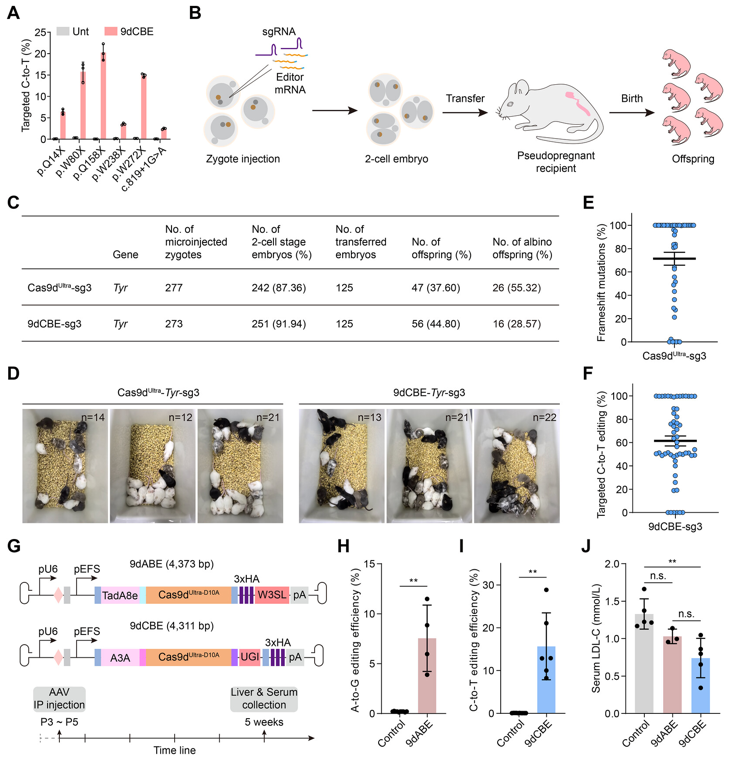
At the embryonic level, the team targeted the mouse Tyr gene, screened out the optimal gRNA, and then microinjected editor mRNA and gRNA into fertilized eggs. Blastocyst development rate is relatively high and cytotoxicity is low; Most F0 mouse tyrs were disrupted, and deep sequencing of the predicted off-target sites in fully albinistic mice did not detect off-target editing.
In vivo therapeutic scenarios, a single AAV delivers 9dBEs targeting the liver Pcsk9. After injecting a single AAV vector into newborn mice, both types of editors achieved detectable base editing in the liver, ultimately resulting in significantly lower serum LDL-C levels compared to controls, validating the feasibility of delivering and intervening in metabolic genes via a compact editor via single AAV in vivo and providing proof of concept for therapeutic application.
GentleGen NGSafety™: Redefining safety assessment standards with NGS technology
The advancement of such tools is closely related to NGS safety evaluation processes such as off-target screening, editing efficiency testing, and genome integrity analysis.
GentleGen has launched an innovative NGSafety™ technology platform focused on the quality analysis and testing needs of CGT products , including mRNA-NGSafety™, CRISPR-NGSafety™, AAV-NGSafety™, Lenti-NGSafety™, etc., meeting regulatory requirements with strict quality control systems, precise sample preparation processes, and bioinformatics analysis capabilities. GentleGen's NGSafety™ platform has helped multiple clients in the CGT field successfully file IND applications in China or the United States.
GentleGen is committed to promoting the standardization and precision of biopharmaceutical safety evaluation through NGS technology, helping pharmaceutical companies improve R&D efficiency, reduce clinical risks, and accelerate drug market launches. For more details about related services, you can send an email to marketing@gentlegen.com.