






What is the basic structure of antibody drugs?
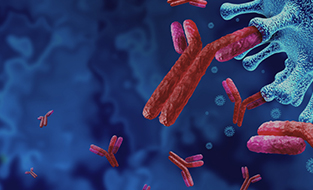
Antibodies are immunoglobulins or their functional fragments, with their core feature being the ability to specifically identify disease-related targets through antigen-binding regions (complementary decision regions, CDRs). CDR1, CDR2, and CDR3 in the antibody variable region are key regions determining binding specificity, with CDR3 contributing the most. The Fc segment mediates immune effector functions such as ADCC and CDC.
IgG is the most abundant type of antibody in the blood, composed of two heavy chains and two light chains connected by a hinge region. After hydrolysis by different enzymes, antibodies can form functional fragments such as Fab, Fc, and F(ab')2. These fragments retain binding activity while having smaller molecular weights and better tissue penetration.

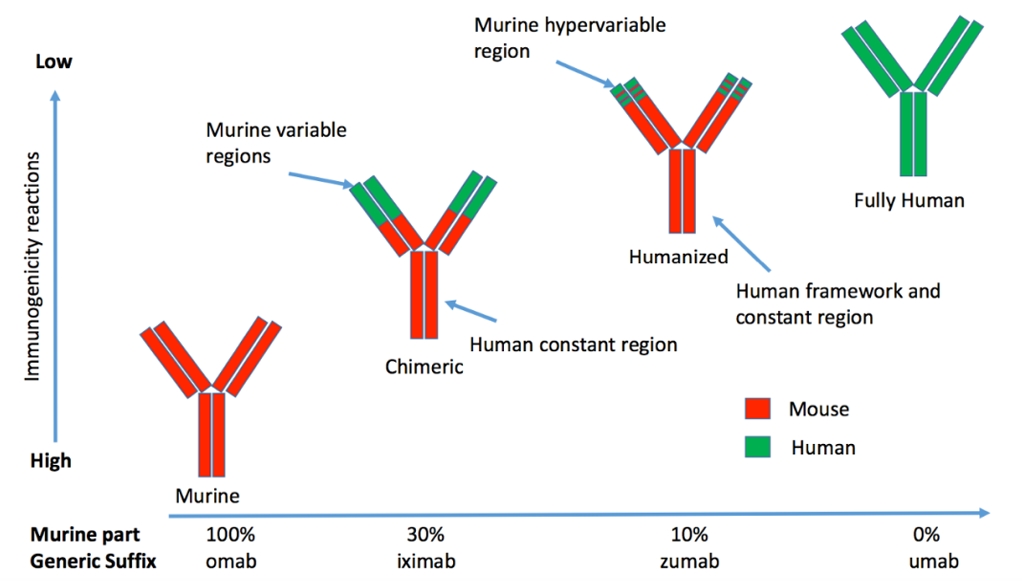
From an immunogenicity perspective, antibody drugs have evolved from mouse to fully human origin: mice antibodies have the highest immunogenicity; The chimeric antibody contains 30% mouse-derived sequences; The mouse sequence in the humanized antibody was reduced to 10%; Fully human antibodies are entirely human sequences with the lowest immunogenicity.
What are the pathways to antibody discovery? How to choose?
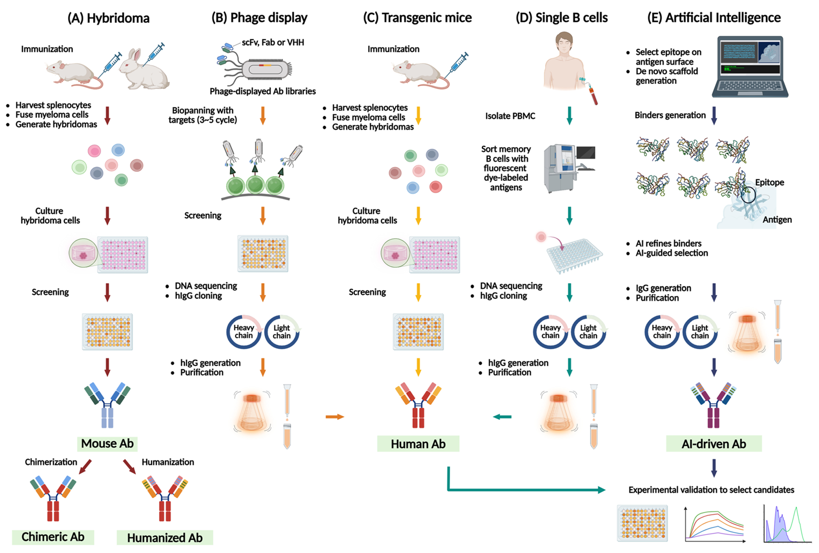
Hybridoma technology: Classic platform, after immunizing animals, fuses B cells with myeloma cells to obtain hybridoma cell lines that continuously secrete antibodies, which can then be humanized.
Phage display: Display the antibody gene bank on the phage surface and screen and clone through 3-5 rounds of "adsorption-elution-amplification," suitable for discovery of difficult-to-immunize targets or fully human antibodies.
Transgenic mice: carry human antibody genes and directly produce fully human antibodies after immunization.
Single B cell sorting: Memory B cells are isolated from the peripheral blood of recovered or immunized individuals, retaining natural heavy and light chain pairings, suitable for rapid antibody detection of infectious diseases.
AI de novo design: Starting from epitope prediction and sequence generation, antibody conjugates are designed from scratch, suitable for targets difficult to obtain by traditional methods.

Each of the five pathways has its own advantages, and the choice depends on the characteristics of the target, species requirements, and the project stage. GentleGen integrates multiple discovery capabilities, supporting the entire workflow from antibody variable region sequencing to AI-based antibody sequence design.

How do high-throughput expressions connect with affinity testing?
In the early days of antibody discovery, candidate clones can number anywhere from dozens to hundreds. High-throughput supernatant expression utilizes transient transfection of HEK293 or CHO cells, allowing parallel processing of multiple antibody genes. The resulting supernatant can be directly used for downstream functional validation and preliminary screening, eliminating the need for purification steps.
Depending on the development stage, different affinity testing methods can be selected: ELISA is suitable for large-scale preliminary screening, has high throughput and low cost, but can only obtain semi-quantitative data; BLI can detect in real time without labels, requires relatively low sample purity, can detect coarse supernatants, and is suitable for kinetic sequencing of positive clones; SPR has the highest sensitivity and highest data recognition, making it the gold standard in the application stage, but it has low throughput and extremely high requirements for sample purity.
During the screening stage for hybridoma or phage display, rapid ELISA screening is preferred; Entering the positive clone screening stage, BLI is recommended to perform kinetic testing directly on the crude supernatant; After confirming the lead molecule, KD was precisely measured using BLI or SPR; During the candidate drug characterization stage, SPR must be used to complete the application-level data.
Why does safety evaluation span the entire lifecycle?
Safety evaluation focuses on cell line construction, process development, and clinical research stages, making it a key focus for regulatory review.
Monoclonal origin testing: Confirms that the cell line originates from a single ancestral cell, ensuring "clonal uniformity" and avoiding batch differences.
Integration site detection: locates the insertion sites of foreign sequences in the host genome to ensure "integration security" and prevent activation or destruction of adjacent genes that could lead to malignant cell transformation.
From antibody discovery to safety evaluation: Junji Biotech's one-stop service platform
Relying on its independently developed GentSyn-Exp3.0G-Lab fully automated production line, GentleGen has built a one-stop, high-throughput technology platform covering gene design, synthesis, validation, protein expression, and antibody affinity characterization.
Antibody discovery and sequencing: phage display library synthesis, single B cell sequencing, first/second/third generation sequencing, Sanger sequencing can measure complex sequences such as PolyA and ITR.
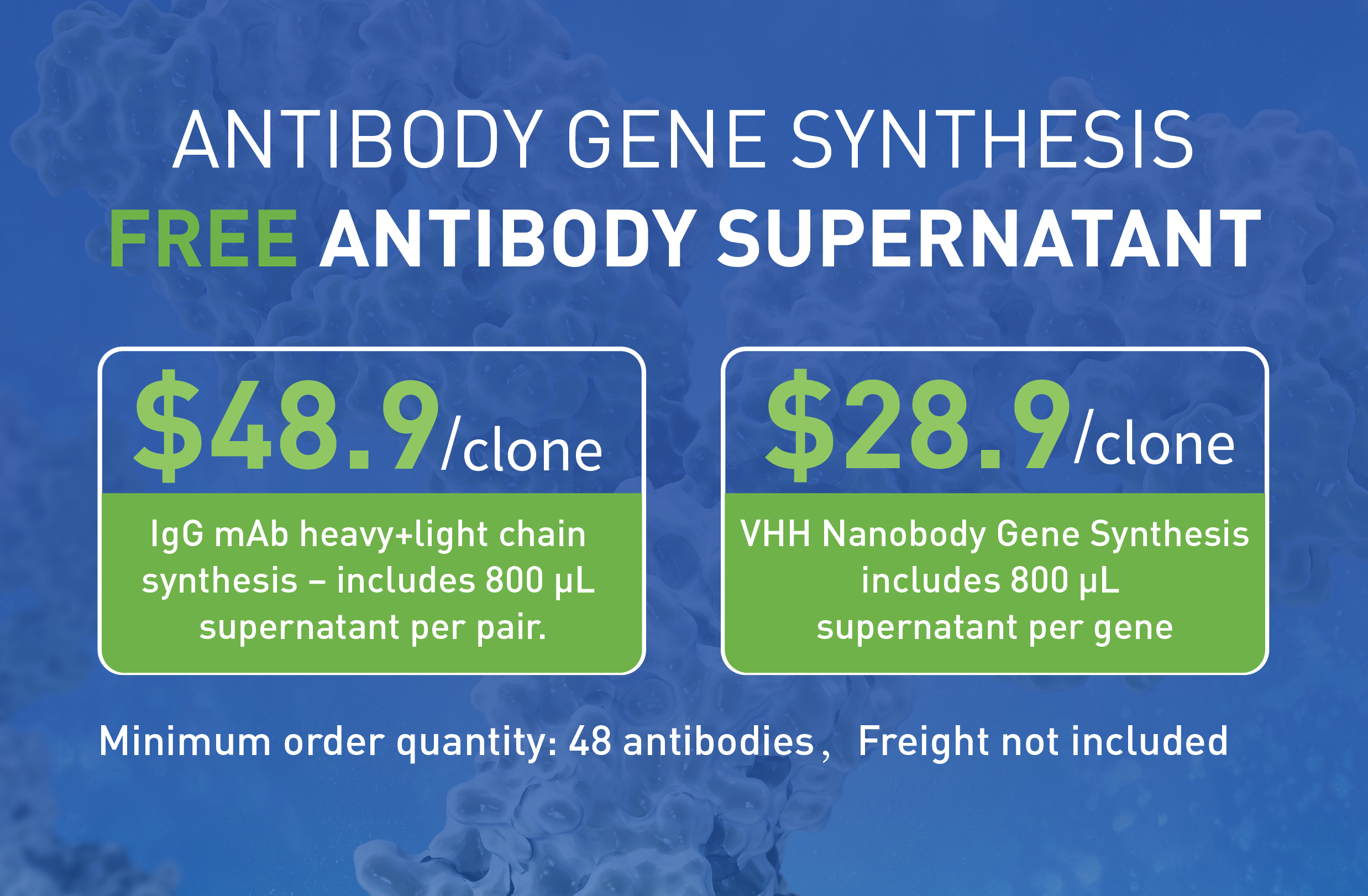
High-throughput antibody expression: High-throughput expression screening greatly reduces the detection cost of individual samples—IgG monoclonal antibody at 48.9 USD/clones, VHH nanobody at 28.9 USD/clones. Each antibody comes with an 800 μl of antibody supernatant that can be directly used for functional validation—eliminating purification steps and skipping intermediate steps, providing one-stop downstream testing from genes to antibodies.

Affinity testing: GentleGen offers three major affinity testing platforms: ELISA, BI, and SPR, covering the entire process from early-stage high-throughput screening to precise candidate molecular characterization.
Safety evaluation: Integrated sites for monoclonal origin detection and WGS detection.
Mutation library: high mutation accuracy, coverage, and uniformity, with customizable mutation sites and types.
No matter what stage of antibody discovery you are in—from large-scale initial cloning screening, to kinetic sequencing of positive clones, and precise characterization of candidate molecules—GentleGen can match you with the most suitable solution and provide one-stop services from samples to data reports. For more details about related services, you can send an email to marketing@gentlegen.com.