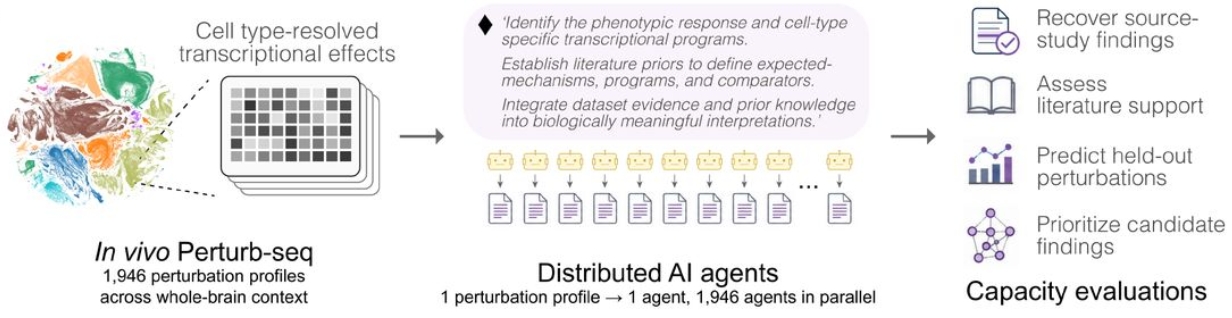









On October 21, OpenAI, together with PerturbAI and Scripps Research, released the GPT-Rosalind distributed AI Agent system: nearly 2,000 independent AI agents were mobilized to analyze large-scale CRISPR disturbance maps in mouse brains in parallel, completing the analysis process that would require months for human teams. Opening up a new paradigm for high-throughput functional genomics interpretation.
High-throughput CRISPR screening pain points: massive data and lagging interpretation
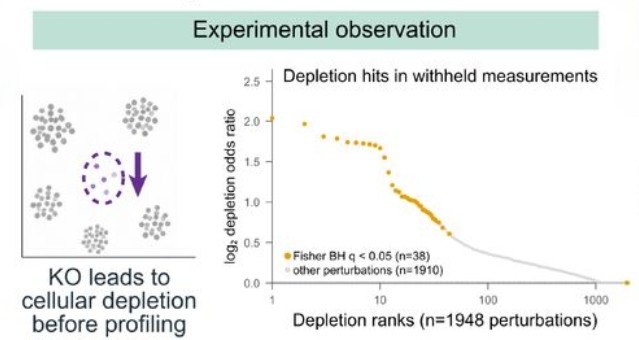
Large-scale in vivo CRISPR screening can systematically knock out genes, observing transcriptional phenotypic changes in different cell subtypes after each gene disturbance, making it a powerful tool for discovering targets related to neurodegenerative diseases and brain development.

This dataset contains 7.7 million mouse brain cells and covers nearly 2,000 target gene knockout perturbations, making it one of the largest causal genome datasets in brain tissue to date.
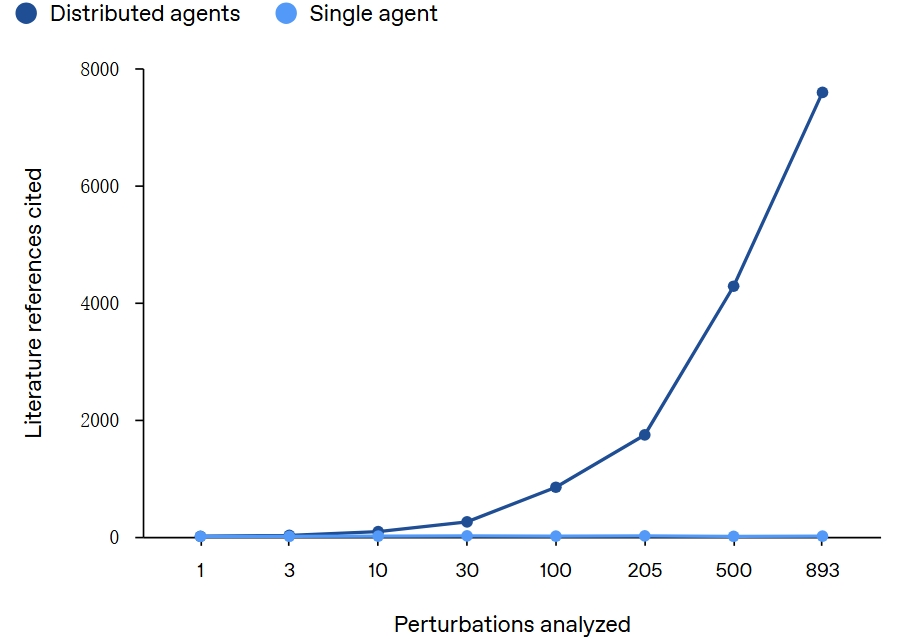
Traditional analysis process: bioinformatics personnel handle data, analyze differences, enrich analysis, manually review literature, and derive molecular mechanisms. The larger the dataset, the more pathways, literature, and cell subtypes need to be compared, which easily leads to incomplete mechanism interpretation, missed potential targets, and subjective bias, resulting in extremely high labor costs.
GPT-Rosalind solution: Each Agent is responsible for one gene
This system adopts a distributed division of labor strategy: each AI Agent is assigned a target gene to be knocked out. The workflow of a single agent:
Reading transcriptional changes of all brain cell subtypes after gene knockout;
Independently searching PubMed, related reviews, and channel databases;
Reasoning about downstream molecular events caused by gene disturbances;
Produce traceable mechanism hypotheses and directions for potential disease associations;
Ultimately, the summary module integrates all agent conclusions, cross-checks, removes contradictory inferences, and forms a complete and searchable causal map.
The entire massive analysis task took only 32 minutes. In blind test evaluations, domain experts are more likely to recognize the interpretation reports produced by AI Agent clusters in 75% of scenarios.
The knockout of TSC1 and TSC2 reveals surprising functional differences
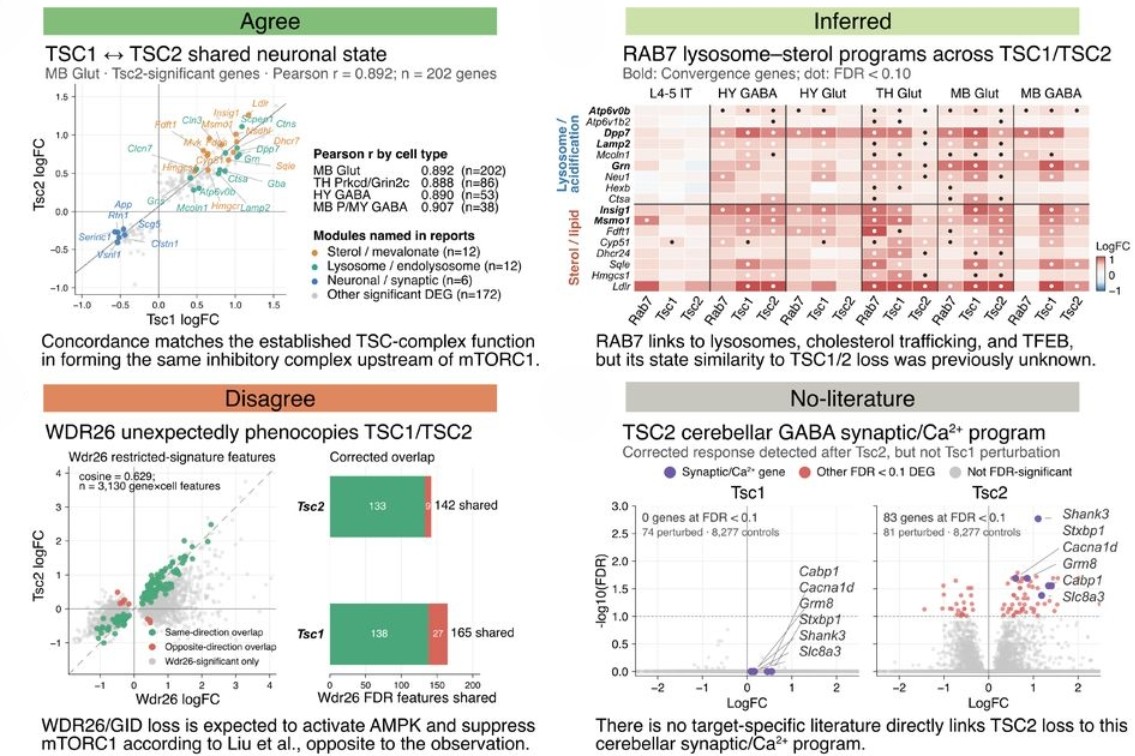
Among the many important hypotheses uncovered by the AI cluster, the most surprising result is Tsc1 and Tsc2.

In long-term understanding, Tsc1 and Tsc2 form a complex that synergistically regulates the mTOR pathway, jointly managing cell growth, metabolic homeostasis, and cellular aging. The two are often assumed to be highly functional partners.
However, this set of brain CRISPR perturbation data shows that knockout Tsc1 alone and Tsc2 alone trigger distinctly different transcriptomic phenotypes in different brain cell subtypes, with significant differentiation in downstream activation amplitude and cell fate trajectory.
This finding suggests that, in addition to forming complexes to jointly inhibit mTOR, Tsc1 and Tsc2 also have complex-independent functions, providing a new entry point for mechanistic research in tuberous sclerosis, age-related encephalopathy, and neurotumors.
In addition, AI has also identified the association between DCTN1 disturbances and neuronal cholesterol transport homeostasis, pointing to potential interventions for neurodegenerative diseases such as ALS and Parkinson's.

This also means that AI Agents are no longer just for statistical mapping and differential gene screening, but have the capability to "propose biological mechanism hypotheses and challenge existing pathway understandings."
Industry Insights: AI Agents have become a new model for research and development
In the past, AI was mostly positioned in genomics for standardized bioinformatics tasks such as plotting, statistics, dimensionality reduction, and enrichment. GPT-Rosalind represents a new generation direction: research agents with independent reasoning, literature retrieval, and scientific hypothesis generation capabilities.

This model is especially suitable for experiments that generate massive amounts of data, such as CRISPR library screening, single-cell perturbation, and high-throughput phenotypic screening. In the future, researchers can focus their energy on experimental design, functional validation, and translational decision-making, while entrusting heavy data analysis and initial mechanism screening to AI intelligent clusters.
AI Agent clusters greatly improve the efficiency of interpreting high-throughput CRISPR filtered data, but the hypotheses provided by AI are merely inferences. All gene functions, pathway relationships, and disease associations still require cell-level knockout or replenishment, oligonucleic acid silencing, and protein interaction experiments to be verified one by one. Moving from single-point predictive models to multi-agent collaborative research is a new direction worth continuously tracking in AI pharmaceuticals and functional genomics.
GentleGen: One-stop gRNA library service
Relying on CRISPR to screen and mine potential targets, stable and reliable library construction and subsequent validation systems are indispensable.
GentleGen has built a gene service technology platform integrating automation and intelligence, embedding an integrated link between gene synthesis, oligonucleotide synthesis, high-throughput sequencing, and gene editing services, providing a truly standardized, highly precise, and cost-effective one-stop solution for CRISPR sgRNA library construction and screening.
Ultra-high synthesis accuracy ensures every sgRNA is precisely positioned
Relying on its self-developed oligonucleotide synthesis platform, GentleGen has achieved an ultimate mutation rate of 1‰ in oligonucleotide synthesis—meaning that for critical sequence lengths, GentleGen can ensure that over 90.5% of sgRNA sequences perfectly match theoretical designs, guaranteeing precise targeting of every gRNA from the sequence source!
Coverage ≥99%, uniformity <10, using data to define the standards for high-quality libraries
Coverage and homogeneity are the "golden dual cores" for evaluating document quality. Under a strict quality control system, GentleGen delivers over 99% library coverage to clients, while maintaining an industry-leading level of uniformity below 10.
High-standard quality control + NGS deep sequencing verification, data speaks for itself at a glance

Once the library is built, it is not simply a matter of packaging and shipping. GentleGen independently validates every delivered plasmid library strictly according to the NGS sequencing depth standard ≥300×, delivering high-purity, endotoxin-free plasmids (total ≥ 200μg), allowing you to control quality right from the "first mile" of experiments without extra effort.
A path just for you, with customizable personalized library solutions
There are many directions for basic research or drug development. For whole-genome exploration, GentleGen can directly provide standardized human and mouse whole-genome knockout libraries to support large-scale genetic screening efforts. For specific needs for precisely targeting specific signaling pathways or target gene sets, GentleGen's customized services are always on standby, tailoring and synthesizing each client's unique targets.
From screening to validation, chain-based delivery enables closed loops to arrive faster
Relying on strong NGS bioanalytical capabilities and long-term gene editing experience, GentleGen is not limited to library plasmid construction—from lentiviral packaging, cell infection, screening pressure application, to final high-throughput sequencing and data analysis, GentleGen can scientifically and reasonably integrate generations, helping researchers shorten project cycles, quickly lock onto "targets," and achieve a complete validation closed loop.
For detailed information about related services, please send an email to marketing@gentlegen.com.