











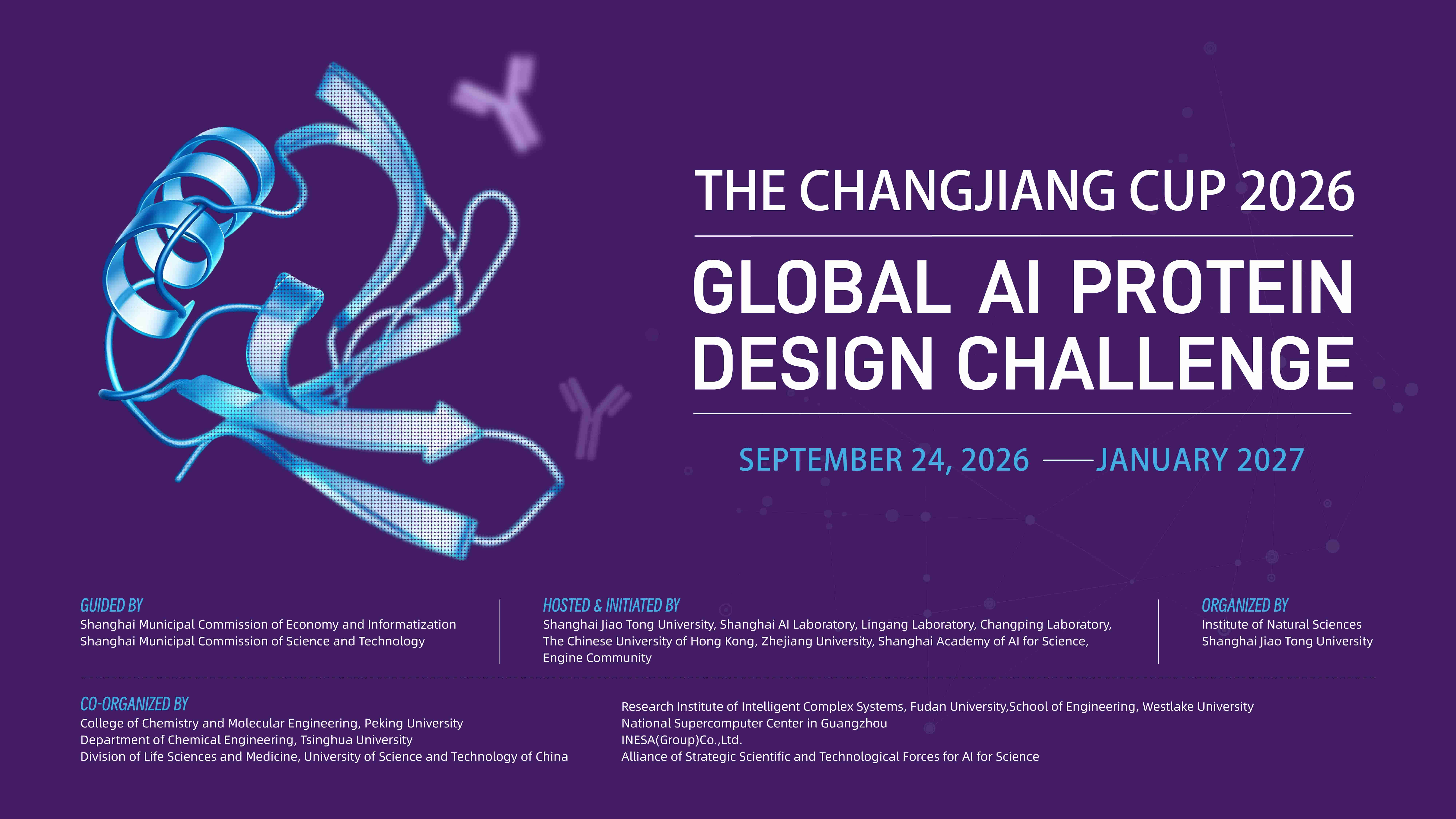
On November 1, the highly anticipated Changjiang Cup 2026 Global AI Protein Design Challenge officially announced its targets, marking the full launch of the competition.
The challenge is jointly initiated by multiple institutions, including Shanghai Jiao Tong University, Shanghai AI Laboratory, Lingang Laboratory, Changping Laboratory, the University of Hong Kong, the Chinese University of Hong Kong, Zhejiang University, and the Shanghai Academy of AI for Science. It has gathered more than 1,800 teams and over 4,000 participants from around the world. Faced with such a massive volume of AI-generated designs, the organizing committee made a major commitment: providing free wet-lab validation for approximately 7,000 shortlisted candidate sequences.
Why does AI design need GentleGen?
In today's AIDD boom, algorithms can generate tens of thousands of candidate molecules a day. But the industry's open secret is that the true wet-lab binding hit rate of de novo AI-designed antibodies or nanobodies is often only 1%–5%.
Many sequences that look perfect on a computer encounter druggability disasters once they enter a real cellular environment—extremely low expression, severe aggregation, poor thermal stability, and more. If a wet-lab platform produces inaccurate data or has a low success rate, AI models not only fail to evolve but can also be led astray by erroneous data. What AI fears most is “invalid feedback” caused by experimental failure.
At this top-tier competition, GentleGen's role is the “touchstone for AI design.” Leveraging its self-developed GentSyn-Exp3.0-G-Lab fully automated production line, we have built an integrated AIDD screening and validation platform, using a true automated wet-lab closed loop to turn virtual sequences into real candidate molecules:
GentleGen's G-Lab fully automated gene and antibody platform will continue to inject strong momentum into your biopharmaceutical innovation projects through cutting-edge automation technology, ultra-fast delivery capability, and rigorous quality control! GentleGen can provide relevant services. For more details, please email marketing@gentlegen.com.
Seven tracks, with GentleGen supporting real competition
The challenge has announced seven highly challenging real-world targets: EGFR, TNF-α, GLP-1R, TfR1, TL1A, TNFR1, and IL-7Rα. Participants must design VHH (nanobodies) or minibinders. GentleGen will be responsible for wet-lab validation of candidate sequences against two of the targets, providing a real and reliable evaluation benchmark for the competition under rigorous industrial-grade standards.
The competition rules are extremely rigorous: there are no subjective judges—all rankings are determined by actual experimental metrics. Each track will conduct affinity testing on 1,000 sequences, ranked entirely by measured KD values from lowest to highest. The top 50 proteins will also receive free additional druggability and cell activity testing. For participants, this is not only a test of model prediction capability but also a major exam of the druggability of their designed molecules.
Currently, elite teams from many leading institutions worldwide—including Peking University, Tsinghua University, Fudan University, Imperial College London, and the National University of Singapore—have joined the challenge.
GentleGen is honored to serve as a sponsor and supporting organization, standing alongside leading institutions to build this “dry–wet closed loop” bridge for researchers worldwide. Every AI-designed candidate molecule will receive the fairest and most rigorous evaluation on GentleGen’s automated wet-lab platform.